

Noble Path : ค้นหาหนังสือธรรมะ หน้า 6 / 8
หน้าหนังสือทั้งหมด
82
Understanding Craving in Buddhism
knowledge of such ascetics are the Formless Brahma Realms — knowledge gained as the result of developing the formless absorptions [arûpajhâna]. Such ascetics misunderstand that being reborn in the For
This text delves into the Buddhist concept of craving, specifically how its pursuit influences rebirth and suffering. It discusses the misinterpretation by ascetics aiming for the Formless Brahmā real
177
The Enlightenment of the Buddha’s First Disciple
The Enlightenment of the Buddha’s First Disciple
In preaching the Dhammackakapavattana Sutta, the Buddha revealed the Thirty-Seven Factors of Enlightenment [bodhipakkhiyadhamma], the Cycle of Depende
The Buddha, in the Dhammackakapavattana Sutta, introduced the Thirty-Seven Factors of Enlightenment, laying down the framework of the Four Noble Truths and the Cycle of Dependent Origination. Dhammaca

41
ความสุขและหลักธรรมในพระพุทธศาสนา
21697 0005
HAPPINESS
[PERIODICAL REFLECTIONS
by Nicholas C. Woods]
Four Noble Truths
Any newcomer to Buddhism who is
trying to find out something about
the religion will find themselves with
a wide, w
HAPPINESS [PERIODICAL REFLECTIONS by Nicholas C. Woods] Four Noble Truths Any newcomer to Buddhism who is trying to find out something about the religion will find themselves with a wide, wide range o
102
Path of Progress Ethics Quiz Contest
The “Path of Progress” Ethics Quiz Contest receives royal grace from His Majesty the King of Thailand, who kindly bestows the First Place Honour upon the first place winners in the nation. The Award o
The “Path of Progress” Ethics Quiz Contest, supported by His Majesty the King of Thailand, recognized for its contributions to youth morality and behaviour. Growing rapidly from hundreds to over 4 mil
126
The Importance of Right View in Education
second significantly affects the mind. You can take any subject that you teach, whether it is math, or geography, or biology, if a student has wrong understanding, it does not cause that student (or y
Understanding Right View is essential in teaching, applicable to all subjects including math and biology. This profound understanding affects afterlife beliefs, making education crucial in guiding stu
60
Building Merit and Pure Heart
71. ONLY THOSE WITH A PURE HEART WILL BE WITH ME
A person with a pure heart and a clear mind, one whose focus is on gaining merit, is the only kind of person I want to have in my company. Those with d
This text emphasizes that only individuals with a pure heart and clear mind, focused on gaining merit, belong together. Merely being in good company does not ensure merit; active participation in buil
118
Untitled
"That clear sphere is the beginning (pathama magga). It is the path of the Blessed One whereby He attained Nirvana. It is the only path, the straight path; there is no other path. Remember this; never
No content provided for summary.
67
Understanding Dhammakāya in Relation to Paccekabuddhas and Enlightenment
early texts that 'dhammakāya' must be singular. 100 In any case, the verse conveys the meaning that a Paccekabuddha has dhamma(s) as his body (or bodies), where 'dhammas' refers to the qualities perta
This study analyzes the term 'dhammakāya' and its relation to enlightenment. Dhammakāya is presented as a singular concept applying to both the Buddha and Paccekabuddhas, emphasizing that 'dhamma' ref
160
Understanding Transcendental Inner Bodies and Meditation
individual person possesses 18 transcendental inner bodies, which can be reached through advanced stages of meditative absorption. Once a person reaches the Dhammakaya, the purest of all transcendenta
This text discusses the concept of 18 transcendental inner bodies accessed through advanced meditation, reaching the Dhammakaya for profound insights. It also covers the Five Hindrances, which are neg
21
The Inaugural Teaching of the Buddha
He agreed to teach the Dhamma, but remained undecided as to exactly who he should teach first. Eventually, the Bud- dha decided to make the journey to teach the ‘Group of Five’ [pañcavaggiya] who were
The Buddha decided to teach the Dhamma starting with the Group of Five at Isipatana Deer Park. His first sermon, the Dhammacakka pavattana Sutta, serves as a crucial teaching, symbolized by a royal ch
34
Buddhist Teachings on Sensual Pleasures
used to rinse a toilet or the toilet bowl itself, which is soiled with excrement. He also compared the pleasures of the senses to human faces which dogs like to spend their time sniffing.
Thus, the Lo
In this text, the Buddha emphasizes the folly of indulging in sensory pleasures, likening them to dangerous paths and harmful actions. This indulgence is viewed as detrimental, bringing suffering akin
78
Understanding the Noble Truth of Suffering
tial a person might be, it doesn't merit any special consideration on suffering's part — all are equal in the face of suffering. Thus, realization of the reality of suffering for what it really is, to
This section discusses the Buddhist understanding of suffering, emphasizing that all beings are equal in their experience of suffering. It highlights the significance of realizing the Noble Truth of S
138
The Path to Enlightenment in Buddhism
grasping [räga], hatred [dosa] and delusion [moha]. When the mind is sufficiently pure to be released from these three defilements, the mind will attain the Formless Brahma Body.
The defilements assoc
This text discusses the process of achieving enlightenment in Buddhism, focusing on the overcoming of three main defilements: grasping (räga), hatred (dosa), and delusion (moha). It explains the attai
162
Teachings of the Buddha on Nobility and Right Action
ter asking all the monks’ names, the Buddha would ask his. The Buddha knew what he was thinking and asked the man his name. “Ariya” replied the man. In fact, the Buddah didn’t need to be told the man’
In this text, the Buddha teaches that true nobility is defined by one's actions towards living beings. Ariya learns that harming others disqualifies him from being 'noble', resulting in his attainment
203
Buddhist Teachings on Cessation of Suffering
सual realms of existence;
3.2.2.2 Bhavaṭanāḥ: Craving for the pleasure of the "form-absorptions" or for the Brahmā-world;
3.2.2.3 Vibhaṭanāḥ: Craving for the pleasure of the "formless-absorptions"
This text delves into the Buddhist concepts of craving and the cessation of suffering. It describes various forms of craving and how they lead to rebirth, as well as the Noble Truth of cessation where

64
การสนทนาเกี่ยวกับอริยสัจ
OM KANLAYAN
AYANAMIT LETTERS FR
MIT LETTERS FROM KANLAYANAM
FROM KANLAYAD)
MIT LETTERS FROM KANL
NAMIT LETTERS FROM KANLAYANAMIT LETTERS FROM
RS FROM KANL
OM KANLAYANAN
MMIT LETTERS /
ROM KANLAYA/
LET
NAMIT LETTERS FROM KANLAYANAMIT LETTERS FROM RS FROM KANL OM KANLAYANAN MMIT LETTERS / ROM KANLAYA/ LETTERS FRON/ LAYANAMIT LET LETTERS F7/ FROM KANLAYA/ NAMIT LETTER/ ETTERS FROM RS FROM KANLA YANAMI
39
Interpretations of Dhammakāya in Early Pāli Texts
Gombrich, while differently translating the term in this passage as a bahubbiha compound 'dhamma-bodied,' similarly interprets it as an indication that the Buddha's true import is due to 'his teaching
This text delves into various scholars' interpretations of the term 'dhammakāya' within the context of early Pāli suttas. Gombrich views it as 'dhamma-bodied,' emphasizing that the essence of the Budd
102
Wisdom and the Dhammakāya in Buddhist Teachings
Some of the qualities or forms of wisdom listed in the text are exclusive to Buddhas such as omniscience (sabbaññutāna), intrepdity (vesārajjanāna), and the ten supreme intellectual powers of a Buddha
The text highlights unique qualities of wisdom exclusive to Buddhas, including omniscience and the ten intellectual powers. It discusses the dhammakāya as the embodiment of a Buddha's inner wisdom, di
125
Meditation Techniques from An Shigao's Teachings
breathing in, and count two at the end of breathing out. If you
count any other number than two when it should be two, start
counting over from one. If you count any other number than
nine when it sho
…lation, the meditation on the five sense organs, the seven aids to enlightenment, and the eightfold noble path, providing a comprehensive view of Buddhist meditation methodologies. For further details, visit dm…
50
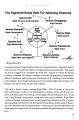
The Eightfold Noble Path for Attaining Dhamma
The Eightfold Noble Path For Attaining Dhamma
1. Samma Ditti - Right View and Understanding
2. Samma Sanggappa - Right Thou…
The Eightfold Noble Path consists of eight practices that guide individuals towards the attainment of Dhamma. Each aspect em…